
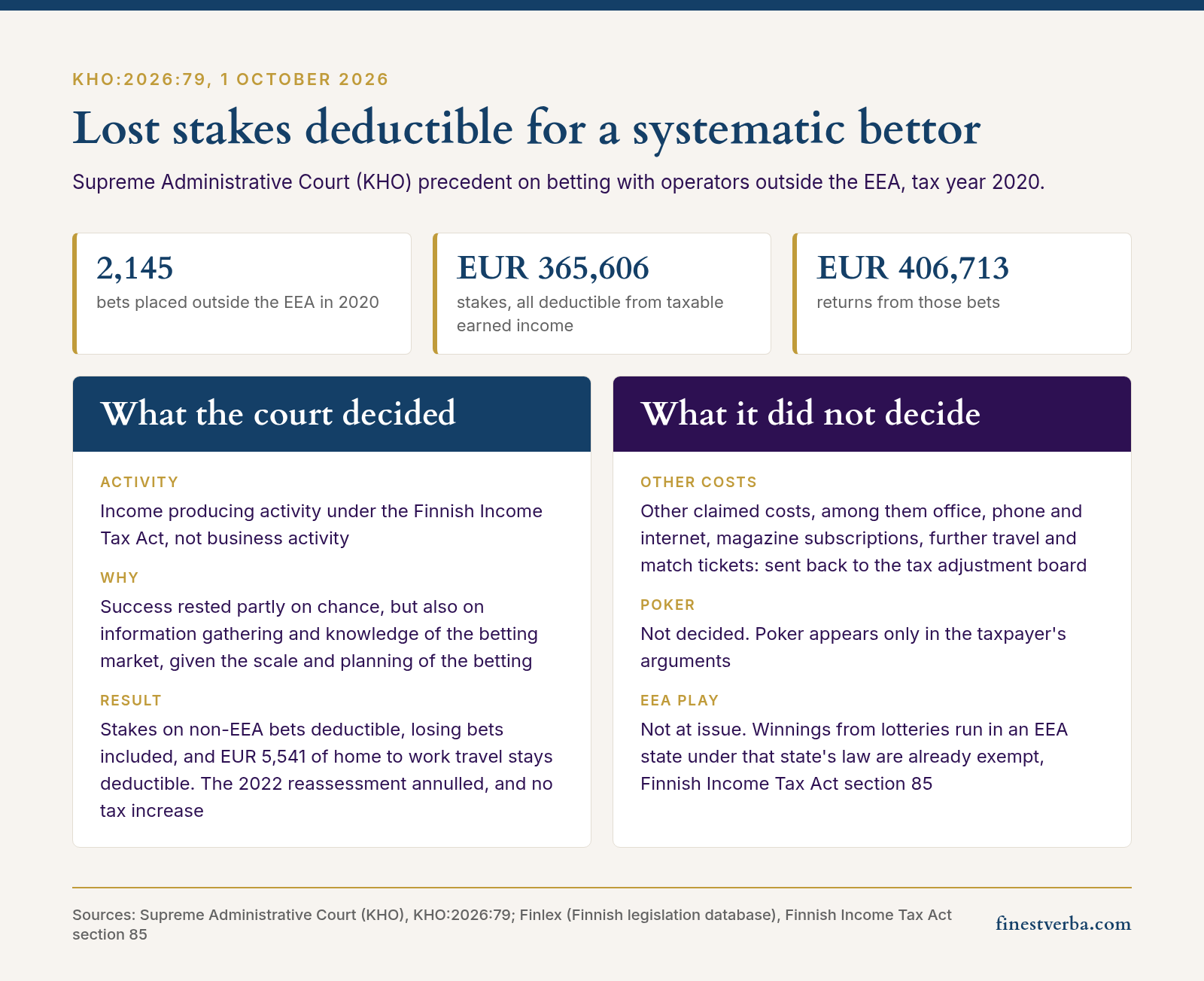
In 2020 one Finnish bettor placed 2,145 bets with operators outside the EEA and staked EUR 365,606 in total. Finland’s Supreme Administrative Court (KHO) has now held that he may deduct all of it, the stakes on his losing bets as well as his winning ones.
The court’s reason: his systematic sports betting was income producing activity. The precedent, KHO:2026:79, was given on 1 October 2026 and concerns tax year 2020.
He got EUR 406,713 back that year. His method, as the court describes it, was information gathering and analysis to find pricing errors in the odds offered on Finnish football matches.
The Tax Administration saw it differently. On 20 September 2022 it reassessed his 2020 taxation and added EUR 112,369.48 to his earned income. Its ground was that a stake was deductible only where it went on a winning bet. The tax adjustment board rejected his claim. The Helsinki Administrative Court rejected his appeal on 17 December 2025.
The Supreme Administrative Court overturned both. It found that the betting was not business activity. Chance played a part in his success, but so did his information gathering and his knowledge of the betting market. Given the scale and planning of the betting, the court held that he carried it on with a stable intention of earning income.
“Näin ollen hänen vedonlyöntitoimintansa oli tulonhankkimistoimintaa.”
Supreme Administrative Court, KHO:2026:79
In English: so his betting was income producing activity.
The result is concrete. He may deduct the full EUR 365,606 in stakes from his taxable earned income, together with the EUR 5,541 of travel between home and work that his original tax decision allowed. The court annulled the 2022 reassessment and held that no tax increase should have been imposed. It also ordered the Tax Administration to pay his legal costs in the Supreme Administrative Court, EUR 5,820.
One part of the case stays open. His other claimed costs go back to the tax adjustment board, among them office, phone and internet costs, magazine subscriptions, further travel costs, increased living costs on work trips and tickets to football matches.
The decision names the taxpayer only as A. Helsingin Sanomat named him on 9 October 2026 as Antti Koivula, a law graduate from Järvenpää, who spoke to the paper about the case. HS describes him as a professional bettor (ammattivedonlyöjä). According to HS, he supported himself and his family by betting from 2010 and stopped betting after 2021.
A word on how I work. I have translated Finnish legal texts since 2010, and before I repeat anything about a court or a regulator, I check what it has published itself. Official sources come first in this article. The taxpayer’s name and the personal details about him come from the press.
What the ruling means for people who bet for a living
KHO:2026:79 is a published precedent. Its reasoning rests on the facts of this case, above all the scale and planning of the betting. As I read it, the precedent does not make every bettor’s losses deductible, and a bettor who wants the same treatment will need records that show betting of that kind.
Then there is the Tax Administration’s own guidance. Its published position on betting outside Finland and the EU/EEA (its wording), dated 27 April 2023, says stakes on losing bets cannot be deducted, and that income and stakes must be itemised bet by bet. I read the ruling as going against that position. As of 25 October 2026 the vero.fi page still shows that 2023 position, and I have found no newer Tax Administration guidance on the point.
Poker comes up only in the taxpayer’s arguments, and the court decides nothing about it. My take: poker players cannot read a result for themselves into it.
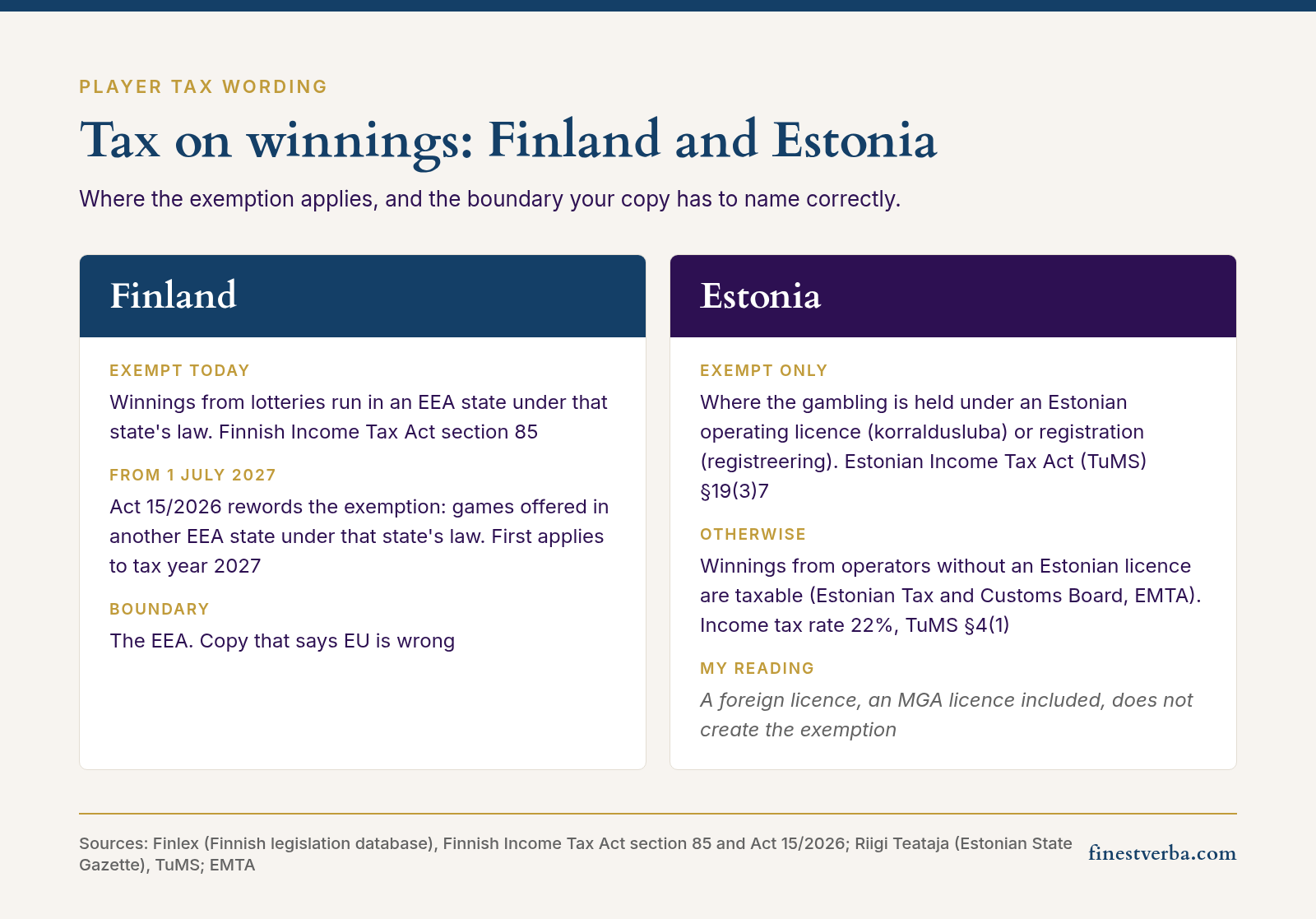
Where the operator sits matters. Section 85 of the Finnish Income Tax Act already exempts winnings from lotteries run in an EEA state under that state’s law. Act 15/2026 rewords the exemption from 1 July 2027 to cover winnings from games offered in another EEA state under that state’s law, and the new wording applies first to tax year 2027. The boundary is the EEA. Copy that says EU is wrong. I read the court ruling as mattering mainly for play with operators outside the EEA.
Estonia ties the exemption to its own licences. In Estonia, winnings are exempt only where the gambling is held under an Estonian operating licence (korraldusluba) or registration (registreering), under the Estonian Income Tax Act (TuMS) §19(3)7. The Estonian Tax and Customs Board (EMTA) confirms that winnings from operators without an Estonian licence are taxable at the income tax rate of 22% (TuMS §4(1)). As I read the Estonian rules, a foreign licence, an MGA licence included, does not create the exemption.
Self-exclusion checks at every login, in draft
Under a draft regulation, Finnish licence holders would have to check a player’s self-exclusion at every login. The National Police Board’s lottery administration consulted on the draft, which covers the interface to the self-exclusion register (POL-2025-77152), under section 45(4) of the Act. The consultation closed on 16 October 2026.
The official text describes one centralised register, regulated in section 29. Under the draft, licence holders must check a player’s exclusion when the player registers, at every login, when the player identifies in a physical channel, and regularly during play. The draft says the regulation enters into force on 1 July 2027.
No adopted version has been found so far. If you are localising Finnish registration and login texts now, my advice is to follow this draft and check the texts again against the final regulation.
Context: the licence regime from 1 July 2027
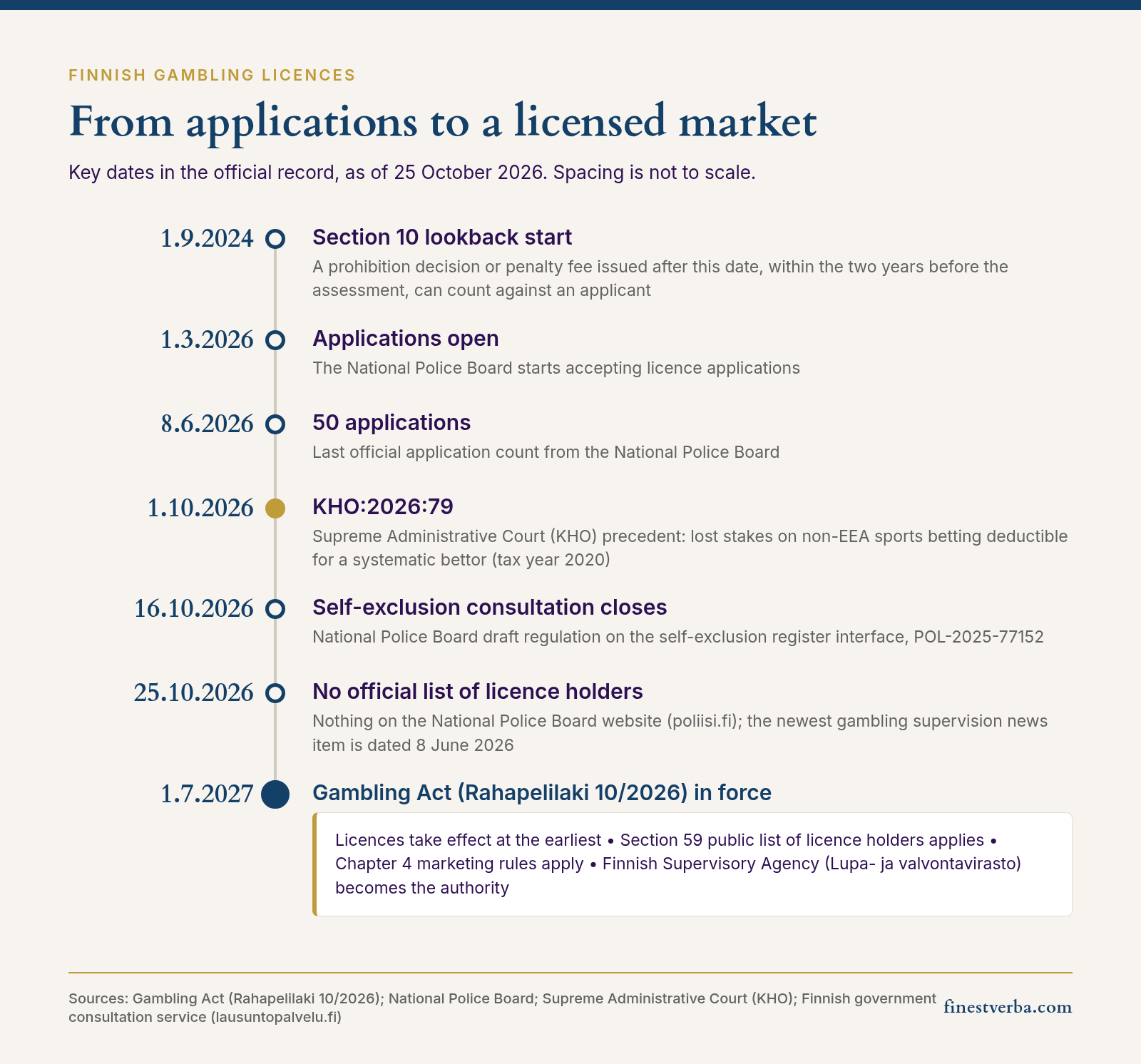
The new Gambling Act, Rahapelilaki 10/2026, enters into force on 1 July 2027. Some parts have applied since 1 March 2026, when the National Police Board started accepting applications. The Board acts as the licensing authority until 30 June 2027, and the Finnish Supervisory Agency (Lupa- ja valvontavirasto) takes over from 1 July 2027.
The Board’s FAQ states that licences can take effect on 1 July 2027 at the earliest, and its gambling activity page states that gambling activity may only start once the licence is in force. The Board’s release of 26 February 2026 says licence holders may offer and market games only from 1 July 2027.
So nobody can lawfully operate under a new Finnish licence before 1 July 2027, and copy that suggests licensed operators are already active is wrong. Until 30 June 2027 marketing stays within the current Act. That Act requires marketing to be moderate and needed to steer demand, and allows some games to be marketed only at gaming venues.
No official list of licence holders yet
As of 25 October 2026, the National Police Board publishes no licence decisions and no list of licence holders on its website, poliisi.fi. The newest item in its gambling supervision news archive is dated 8 June 2026. That release also gives the last official application count I can cite: 50 applications by 8 June 2026.
The Act explains part of the gap. Section 59 requires a public, machine readable list of licence holders, but it is not among the provisions that have applied since 1 March 2026. It enters into force on 1 July 2027.
I read the missing list as a matter of timing in the law. Until it exists, ask for the source whenever a partner pitch or client brief says an operator holds a Finnish licence. From 1 July 2027 marketing must name the licence (radio advertising is exempt from the licence and authority requirement), so a wrong claim becomes a compliance problem.
Every Finnish ad will have to name the licence
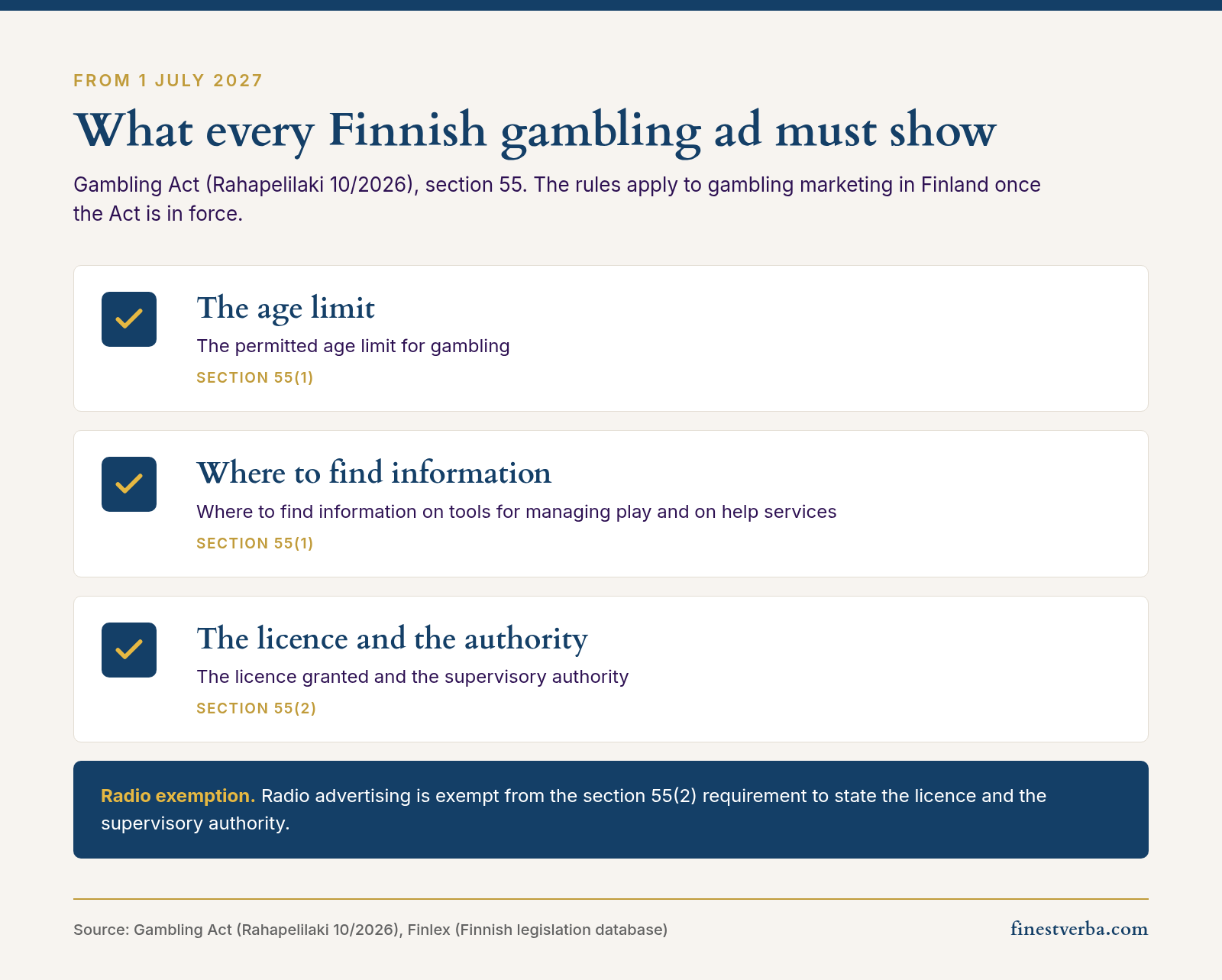
Chapter 4, sections 51 to 56, sets the marketing rules from 1 July 2027. Under section 55(1), marketing must state the age limit and say where to find information on tools for managing play and on help services. Section 55(2) adds a further requirement:
“Markkinoinnin tulee lisäksi aina sisältää tieto myönnetystä toimiluvasta ja valvontaviranomaisesta.”
Rahapelilaki 10/2026, section 55(2)
Every marketing communication must state the licence granted and the supervisory authority. Radio advertising is exempt from that part.
Section 51(7) prohibits any gambling marketing outside the forms set out in subsections 1 to 6. Search advertising is one of the permitted forms: section 51(3)(6) allows keywords that relate directly to the licence holder or the games it runs. The statute does not use the words affiliate or influencer. My reading is that affiliate and influencer marketing fall outside the permitted forms.
Unlicensed marketing now can count against an applicant later
Section 10 lists the situations where an applicant cannot be considered reliable and suitable. Point 8 covers a prohibition decision or a penalty fee issued within the two years before the assessment, and after 1 September 2024.
The enforcement tools behind it come from the current Lotteries Act as amended by Act 1284/2021, in force since 1 January 2022. The Board can issue prohibition decisions and attach conditional fines to them. Since 1 January 2023 it has also kept a public, machine readable list of operators it has banned, and payment service providers must not execute player payments to them.
Here my reading is blunt: a Finnish campaign that runs without a licence this winter can count against you at the licence assessment. If you are applying, treat everything you publish in Finnish before July 2027 as part of your file.
EUR 29,000 to apply, and a target of 6 to 8 months
The Board gives two processing times on pages that were both live on 25 October 2026. Its licence page gives a target of 6 to 8 months and warns that processing may take longer. Its FAQ, in Finnish and in English, still gives a target of 3 to 6 months. I would plan with the longer figure.
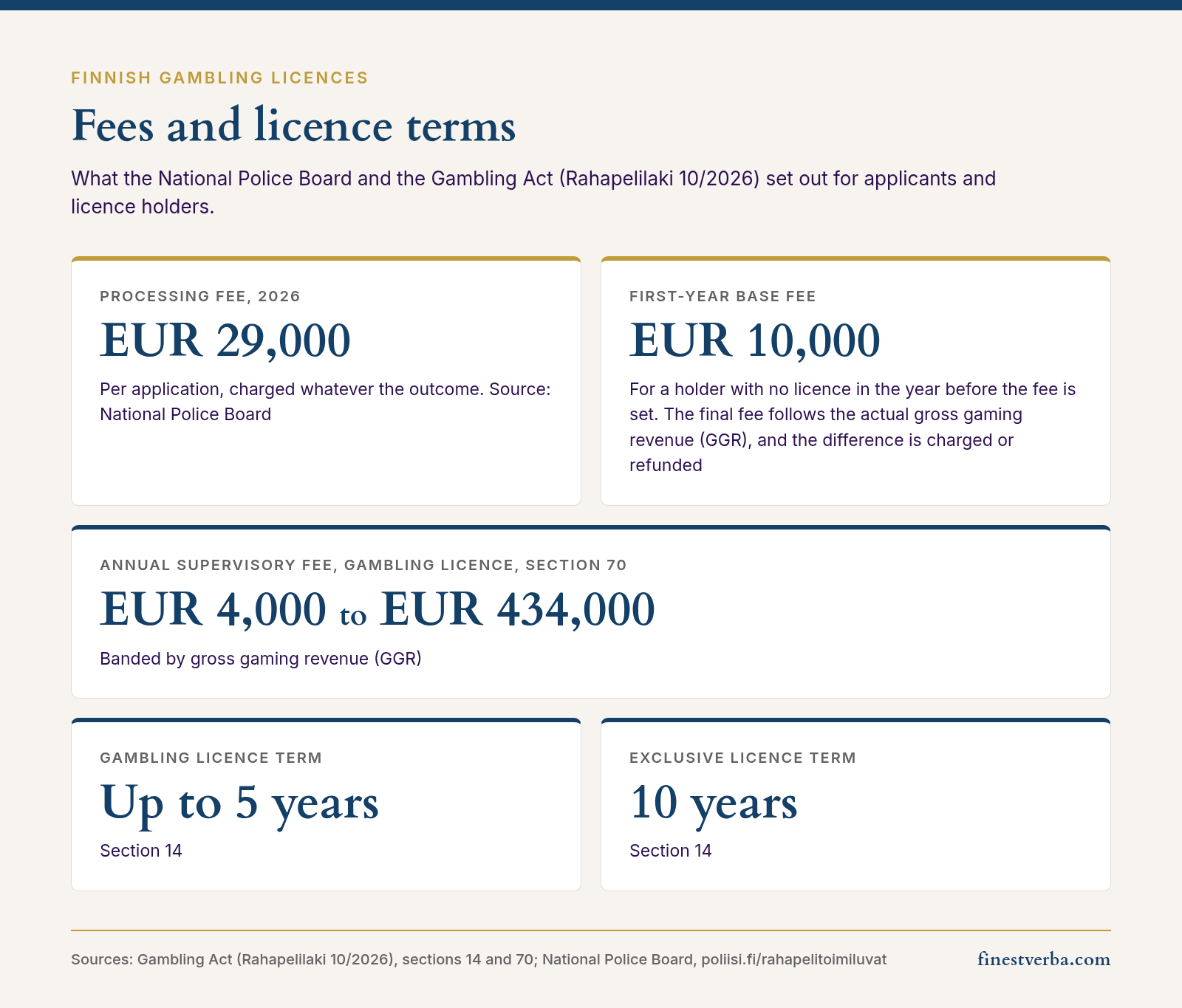
In 2026 the processing fee is EUR 29,000 per application, charged whatever the outcome, according to the Board’s licence page.
Once licensed, a gambling licence holder pays an annual supervisory fee under section 70. It runs from EUR 4,000 to EUR 434,000 and is banded by gross gaming revenue (GGR). If the holder had no licence in the year before the fee is set, it pays EUR 10,000 as the first-year base fee. The authority then sets the final first-year fee from the actual GGR in the approved accounts and charges or refunds the difference. A gambling licence runs for up to five years, and an exclusive licence is granted for ten years. The lottery tax rate is 22% from 1 July 2027 under Act 14/2026.
Applications are processed in Finnish or Swedish, and the Board notes that attachments may need translating. That is usually where my work starts.
How I am handling this in my own work
I am updating my Finland pages to the official record, and client texts get the same rule: official sources first.
If you need Finnish or Estonian compliance content for the 2027 market, I write it regulatory ready, so your legal or compliance team only has to sign off. You can reach me through the contact page.
Sources
- Supreme Administrative Court (KHO), KHO:2026:79, 1 October 2026: kho.fi: KHO:2026:79
- Helsingin Sanomat, 9 October 2026: HS.fi: Vedonlyöjä Antti Koivula voitti verottajan kummallisessa taistossa
- Tax Administration, position of 27 April 2023 on betting outside Finland and the EU/EEA: vero.fi: Muualla kuin Suomessa tai EU/ETA-alueella järjestetyistä vedonlyönti, veikkaus- ja raha-automaattipeleistä saatavien tulojen verotus tuloverolain mukaan
- Gambling Act (Rahapelilaki 10/2026), Finlex (Finnish legislation database): Finlex: Rahapelilaki 10/2026 (sections 10, 14, 29, 45, 51, 55, 56, 57, 59, 70, 106)
- Act 14/2026 amending the Lottery Tax Act (arpajaisverolaki), Finlex: Finlex: Act 14/2026
- Act 15/2026 amending the Income Tax Act (tuloverolaki) section 85, Finlex: Finlex: Act 15/2026
- Act 1284/2021 amending the Lotteries Act (arpajaislaki), Finlex: Finlex: Act 1284/2021
- National Police Board, gambling licences: poliisi.fi: Rahapelilain mukaiset toimiluvat
- National Police Board, licence FAQ (Finnish): poliisi.fi: Usein kysytyt kysymykset toimilupien hakemisesta
- National Police Board, licence FAQ (English): poliisi.fi: Frequently asked questions about applying for licences
- National Police Board, gambling activity: poliisi.fi: Rahapelitoiminta
- National Police Board, marketing of gambling: poliisi.fi: Marketing of gambling
- National Police Board release of 8 June 2026: poliisi.fi: Rahapelitoimiluvat kiinnostavat rahapeliyhtiöitä
- National Police Board release of 26 February 2026: poliisi.fi: Rahapelitoimilupien haku alkaa ensi viikolla
- Consultation POL-2025-77152, Finnish government consultation service (lausuntopalvelu.fi): lausuntopalvelu.fi: Lausuntopyyntö rahapelilain mukaisen peliestorekisterin rajapintaa koskevasta määräysluonnoksesta
- Estonian Income Tax Act (Tulumaksuseadus, TuMS), Riigi Teataja (Estonian State Gazette): Riigi Teataja: Tulumaksuseadus
- Estonian Tax and Customs Board (EMTA), other types of income (updated 26.08.2026): emta.ee: Other types of income
Related
- Finland’s Police Board: 4 gambling marketing bans and 6 conditional fines in 2026
- Marketing Under the Finnish Licence: Operators Memo
- Finland’s Gambling Licence 2027: The Rules Nobody Is Ready For

Compliance content, SEO and legal translation for regulated markets. Finnish, Estonian, English, German, Dutch and Russian. Translating since 2005, legal translation since 2010, terms of service and privacy policy translation for iGaming, crypto and trading platforms since 2017. Founder of FinEst Verba.
Drafting, translation and written analysis. Not legal advice, and no compliance sign-off is offered.
Connect on LinkedIn