
I did not know much about SEO in 2017. I just wrote about something I knew well.
What is the Case?
This is a case study built around a real post I wrote in February 2017 for my Estonian beauty blog on Blogger. I am a CIDESCO-certified esthetician and was working in Helsinki at the time. I wrote it to promote my acid peel and new-generation bioceutical treatments.
Nine years later: I have not lived in Helsinki since 2018, the salon is long gone, and the blog has not been touched since. It still ranks.
Cited in Google AI Overview: June 2026
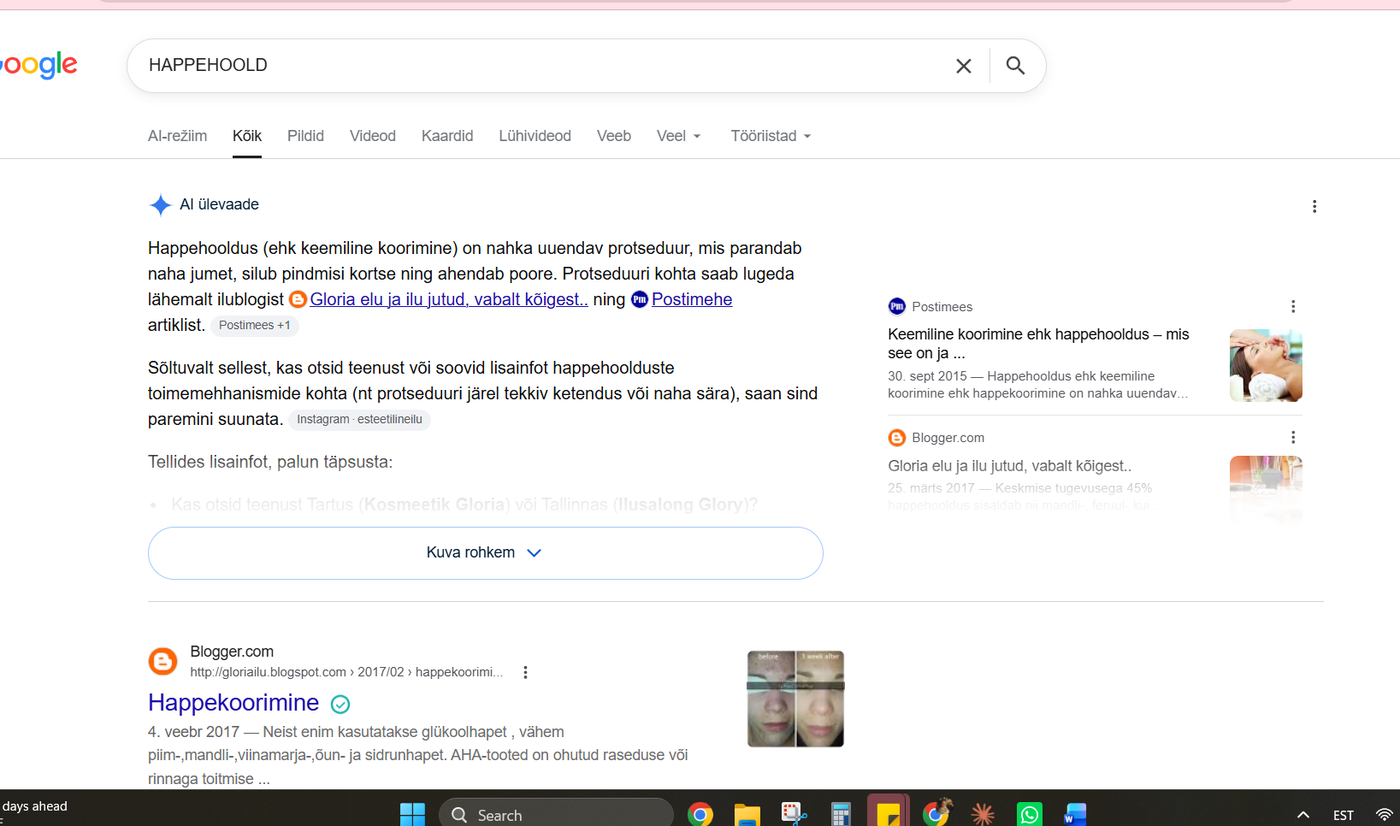
I searched “happehooldus” on Estonian Google in June 2026, and my 2017 Blogspot article appeared in the AI Overview (position 0), the AI-generated answer at the very top of the page, above all organic results, as well as position 1 in SERP. Google’s AI cited my article as a primary source alongside Postimees, one of Estonia’s largest news publications.
The AI overview even used language directly from my article to explain what acid peeling is. This is what happens when content is written by someone who genuinely knows the subject, covers it thoroughly, and uses accurate, specific language.
Screenshot 1: AI Overview citation for “happehooldus”: My 2017 Blogspot post is cited in the Google AI Overview and my article “Happekoorimine” is in position 1, after 9 years.
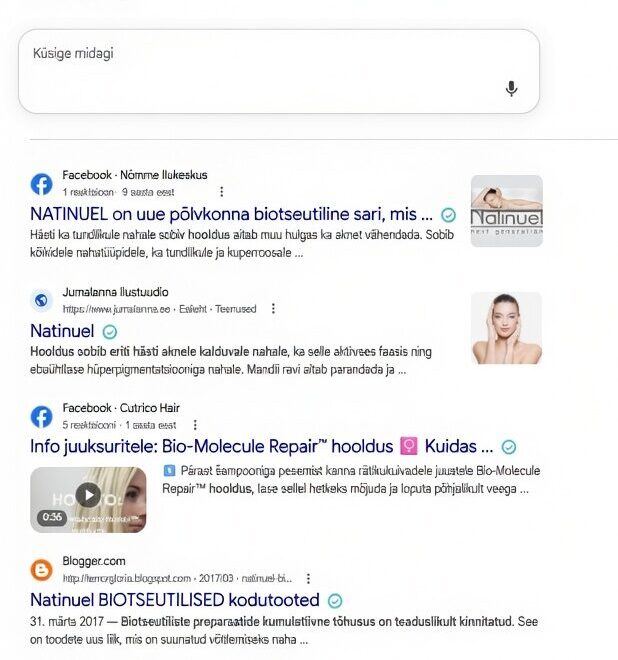
Screenshot 2: A second blog of mine on Blogger showing up in organic results for bioceuticals-related searches in Estonian. A post about “Natinuel biotseutilised kodutooted” from March 2017 is indexed and ranking position 4. Two separate blogs, same pattern.
Neither the platform nor the date matters. A nine-year-old Blogspot post beat out newer, better-optimised content for AI citation because it is the most credible answer available.
This is exactly the point I make in my article “AEO and GEO Are Still SEO“: AI search pulls from the same quality signals as traditional SEO. My abandoned blog is live proof of it.
Read Original Article (Translated from Estonian)
Published: February 4, 2017
Original title: Happekoorimine (Acid Peel / Chemical Exfoliation)
I wanted to write a few lines about acid treatments, which are gaining popularity.
Chemical peeling, also called acid peeling, is one of the most effective and oldest skincare procedures performed by an esthetician. As far back as ancient Egypt and Greece, natural acids were used to soften and rejuvenate the skin. Today’s acids are far safer and more comfortable to use than ever before.
In the treatment, the skin is affected by various biological acids that support the skin’s renewal processes. Alpha-hydroxy acids (AHAs) are organic carboxylic acids found in fruits and other natural sources. They are popular ingredients in cosmetic products. The most commonly used is glycolic acid, followed by lactic, mandelic, tartaric, malic, and citric acids. AHA products are safe to use during pregnancy and breastfeeding. The new generation of acids does not cause discomfort during or after treatment.
Acid peeling is recommended for the following skin concerns:
- Scars
- Pigmentation, uneven skin tone, freckles
- Excessive oiliness or very dry or flaky skin
- Acne
- Dull complexion, stressed skin, smoker’s skin
Medium-strength acid treatments are also suitable for:
- Strengthening delicate skin
- Couperose and enlarged capillaries
- Neutralizing sun damage in summer
A course of acid peeling is recommended 4 to 6 times in a row, with 4 to 10 days between sessions. Two to three courses per year is standard. During the treatment, the practicioner performs a skin analysis and selects the appropriate chemicals. The products are applied to the face, worked in with a stimulating massage, and the session ends with an effective soothing protective cream. The treatment takes approximately 30 to 40 minutes.
After the treatment, mild redness and some flaking may appear for a couple of days. The active ingredients continue working in the deeper layers of the skin for 4 to 7 days after the session, so the final result is visible about a week later. During the first 48 hours, avoid sauna, direct sun, and tanning beds. It is important to use the homecare products your skin specialist recommends, shop-bought creams often contain too many unnecessary chemicals and far fewer active ingredients than professional products.
Photos are not retouched. Real results. My work.
I am a CIDESCO-certified esthetician since 2005 and a makeup artist and beauty consultant since 2002.
Why It Still Ranks (not because of GEO/AEO)
This post was written with zero SEO strategy. No keyword research, no internal linking plan, no structured data. I knew little about keywords, as I had been writing content since 2010, but that’s about it.
The main reason is expert knowledge of the topic. The content answered client questions directly. I explained the session details and the exact number of required visits.
1. Topical authority from real expertise. The article covers the treatment from every angle a potential client would actually wonder about: what it is, who it suits, what the procedure involves, what the aftercare looks like, how many sessions you need, and what the results look like.
This level of depth, written by someone who performed the treatment for a living, is what Google’s E-E-A-T framework rewards.
2. Natural keyword density across related terms. “Happekoorimine,” “happehooldus,” “AHA-d,” “glükoolhape,” “kosmeetik,” “nahauuenemine” appear throughout the text because they are the correct terms for the topic and not forced into it.
Google mapped the semantic relationships between the Estonian text and Finnish search terms like “happohoito”, “happokuorinta”, due to geographic proximity and conceptual accuracy; thus, I also ranked for the Finnish market.
3. Images with real results. The post includes multiple before/after and treatment photos. In 2017, most beauty content on Estonian/Finnish-language blogs did not include real treatment photography. Those images attached to the keyword in the URL and established a lasting presence in image search.
4. A clean, descriptive URL. gloriailu.blogspot.com/2017/02/happekoorimine.html has the primary keyword is in the URL. It’s a small thing but it’s consistently been one of the most reliable ranking signals and that hasn’t changed.
What Would Not Work Today
I’m not saying publish this in 2026 and expect the same results. Publishing the exact same text now requires structural updates for it to rank. The core facts remain accurate, but the delivery mechanism lacks current technical standards.
No structured data. Current search systems require structural formatting that this old post lacks. Machine-readable schema must segment treatment articles. Search intent has changed. People want pricing and location details immediately.
No internal linking. The post lives in isolation. If I were writing it today, it’d link out to related pieces and a booking page, and be linked from a services page. Orphaned content is harder to rank now and harder for AI systems to surface in the right context.
No author credentials in the markup. The post mentions CIDESCO certification in passing at the bottom. In 2026, trust signals require prominence. My CIDESCO certification needs prominent placement and linked author profiles to satisfy quality raters. A custom domain builds necessary authority that a free subdomain lacks.
What to Keep
The writing style. Direct, informative, practical, and grounded in real practice. No filler, no hype. That is exactly the tone that performs well in both traditional search and AI-generated answers. The facts are solid and the advice holds up.
This is a case study in content longevity. Write something true and thorough, and it keeps working long after you’ve moved on.
Or book a free consultation to discuss your content strategy.

Last updated: June 2026
Why this keeps working is covered elsewhere. AEO and GEO are still SEO sets out the mechanism, and a compliance site that went from page 4 to AI Overview citations in 50 days applies it to a regulated market.

Compliance content, SEO and legal translation for regulated markets. Finnish, Estonian, English, German, Dutch and Russian. Translating since 2005, legal translation since 2010, terms of service and privacy policy translation for iGaming, crypto and trading platforms since 2017. Founder of FinEst Verba.
Drafting, translation and written analysis. Not legal advice, and no compliance sign-off is offered.
Connect on LinkedIn
Leave a Reply